How robots.txt applies to AI agents in 2026
What robots.txt actually governs in 2026, how AI crawler tokens work, recipes to allow search and block training, and why verification matters as much as rules.
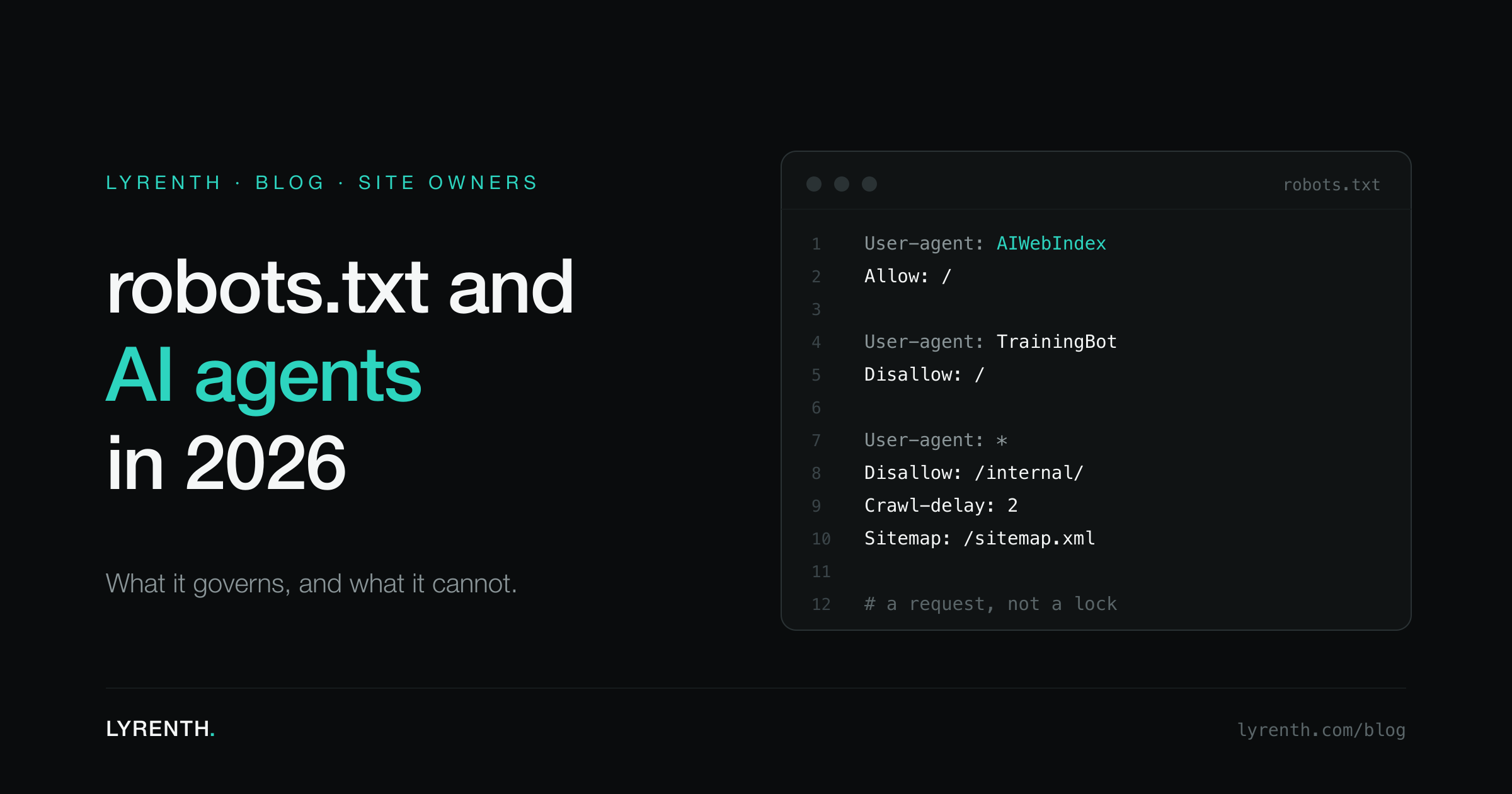
robots.txt is a 1994 idea having its biggest year since 1994. A plain text file that politely asks robots to stay out of certain paths has become the frontline document in the negotiation between the web and AI, and in 2026 it is doing jobs it was never designed for. Here is what it actually governs, what it cannot do, and how to write one that says what you mean.
What robots.txt actually is
Since 2022, robots.txt has a formal specification: RFC 9309, the Robots Exclusion Protocol. The mechanics are simple. A crawler is expected to fetch /robots.txt before crawling, find the group whose User-agent line matches its product token, and obey the Allow and Disallow rules in that group. A Disallow: / under its token means: do not crawl this site.
Two properties matter more than everything else:
It is scoped to automatic clients. RFC 9309 governs crawlers, programs that autonomously choose what to fetch. It was never a general access-control system.
It is voluntary. robots.txt is a request, enforced by the reader's good behavior, not by the server. A compliant crawler obeys it exactly; a bad actor ignores it entirely. This single fact explains most of what has changed around it in 2026.
What changed in 2026
Purpose-labeled crawling became the norm. The big operators now run separate crawlers for separate jobs, with separate tokens, so a site can allow one purpose and refuse another. This mirrors the taxonomy Cloudflare is now enforcing at the network level: search, agent, and training are different behaviors deserving different answers, and combined-purpose crawlers are increasingly treated by their most expansive behavior.
Machine-readable rights reservations grew up alongside it. robots.txt says what may be crawled; TDM reservation signals and robots-meta directives like noai and notrain say what may be done with content afterward, reserving text-and-data-mining and AI-training rights. They answer a different question than robots.txt and well-behaved indexers honor both.
Enforcement moved into infrastructure. Because robots.txt is voluntary, 2026's real shift is that networks and CDNs began enforcing crawl policy at the edge, with defaults, categories, and verification. The polite file did not get teeth; the teeth grew around it.
Writing a robots.txt that says what you mean
A few recipes, using the real mechanics.
Allow search-class indexing, refuse a specific bot:
User-agent: SomeBot
Disallow: /

User-agent: *
Allow: /
Keep private sections out of every well-behaved crawler:
User-agent: *
Disallow: /internal/
Disallow: /drafts/
Refuse one purpose without refusing discovery. Because operators split crawlers by purpose, you can now target the purpose by targeting its token. Check each operator's published documentation for which token does what, and write a group per token. The precision only works when bot operators are honest about their tokens, which is where verification comes in below.
Three mistakes to avoid: rules for the wrong token (a group only binds crawlers whose token matches), assuming robots.txt hides content (it is public, and disallowing a path advertises that the path exists), and treating it as security (it is a request; access control belongs in authentication).
How Lyrenth reads your robots.txt
We can speak precisely for our own crawler, because the policy is public and singular. Lyrenth's crawler matches the token AIWebIndex, and it implements RFC 9309 in full: Disallow rules, Crawl-delay, Sitemap directives, backoff on 429 and 503, and per-domain rate caps. Two details worth knowing because they are stricter than the RFC requires:
- Every fetch obeys, on every path. Whether a page is fetched by our scheduled crawler or on demand because an API customer asked the index for a URL it did not hold yet, the same rule applies: a URL your robots.txt disallows for our token is not fetched, not indexed, and not served, and the API request is refused with an explanation instead. There is no customer override.
- We fail closed. If your robots.txt cannot be read at all and we hold no cached copy, we treat the site as disallowed until we can read it.
We also honor TDM reservations and noai-family directives, and we do not train foundation models on crawled content. The full policy, including both of our User-Agent strings and every opt-out mechanism ranked by strength, is on the crawler policy page.
The missing half: verification
Here is the uncomfortable truth about every recipe above: a robots.txt group binds a token, and a token is just a string. Anyone can send User-agent: Googlebot. In 2026, a crawl policy without verification is a lock without a door.
Verification is how the honest half of the ecosystem is fixing this: cryptographic request signatures (Web Bot Auth, the scheme Cloudflare's verified-bots program uses), published IP ranges, and forward-confirmed reverse DNS. A crawler that gives you all three can be held to its stated purpose; one that gives you none of them is asking for trust it has not earned. Our own verification surface is documented on the bot page, and your server logs can be checked against it in minutes.
For site owners who want the full picture of who reads them, purpose by purpose, verified against impostors, that is what our bot analytics shows, free with domain verification.
The one-paragraph summary
robots.txt in 2026 is the web's statement of intent: scoped to automatic clients, voluntary by design, newly precise thanks to purpose-labeled tokens, and newly meaningful because infrastructure started enforcing it and verification started proving who is who. Write yours deliberately, pair it with rights signals if you have training concerns, and extend trust to crawlers that prove their identity and publish their policy. The ones worth allowing are the ones that make it easy to check.