How fresh is an indexed page? Staleness, recrawls, and forcing a refresh
Cached reads are fast and cheap, but pages change. How freshness works in an AI web index: documented cache ages, change-driven recrawls, and per-request refresh.
The first question people ask about reading from an index instead of the live web is the right one: what if the page changed?
It deserves a straight answer, because the alternative answers are both wrong. "Always fetch live" pays full latency and full tokens for every read and increasingly gets refused at the door. "Trust the cache blindly" eventually quotes last month's price as today's. Freshness is not a yes-or-no property; it is a contract, and the contract should be explicit.
The documented maximum age
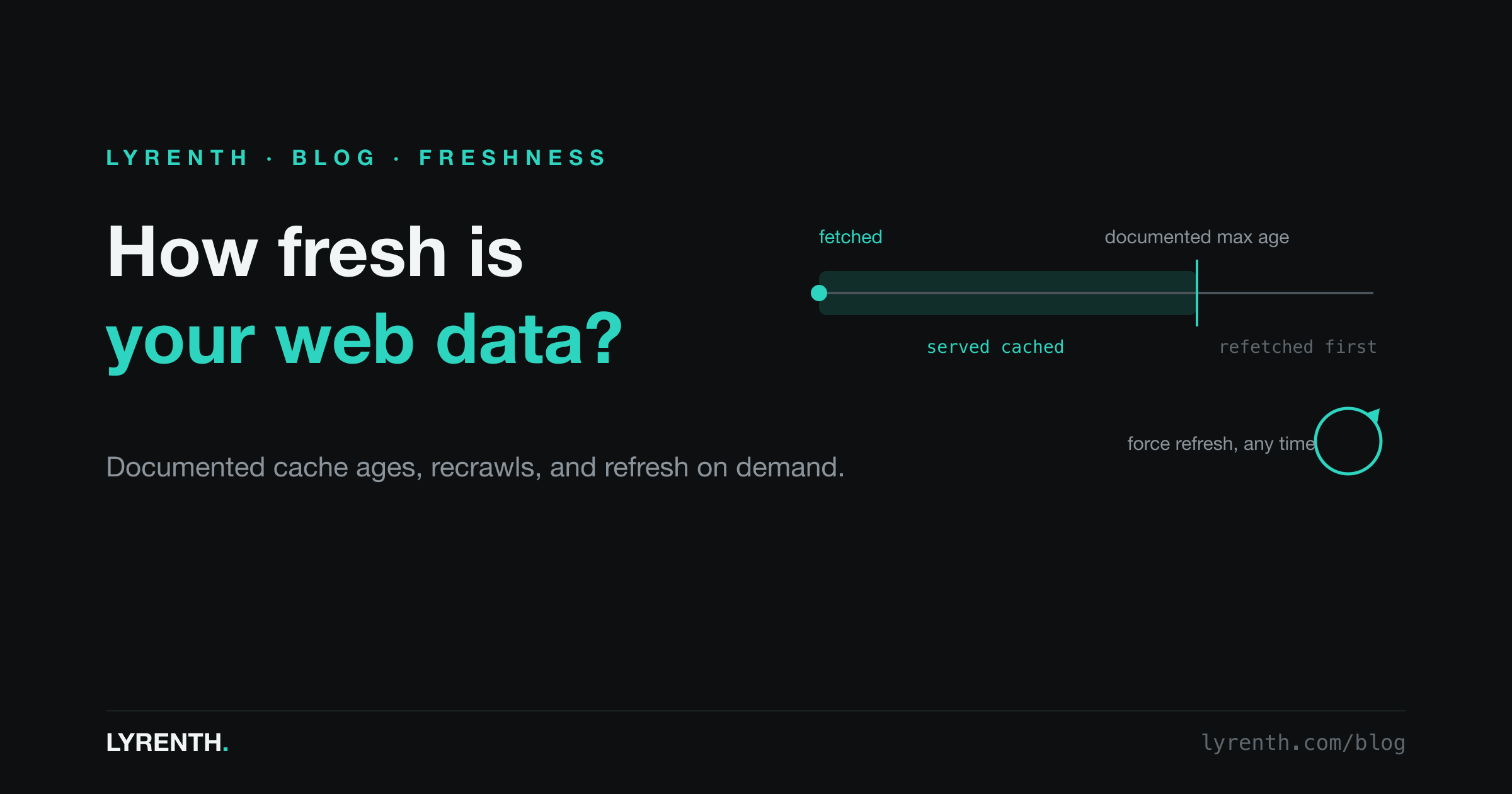
Every Lyrenth plan states, on the pricing page, the oldest a cached document is allowed to be when served to you. If the stored copy is older than your plan's ceiling, your read does not get the stale copy; the page is fetched fresh, re-extracted, and the updated document is both served to you and stored for the next reader. Staleness has a published upper bound, not a vibe.
Reads keep the index alive
An index used by many agents has a property a private cache never gets: demand tells it what matters. Pages that agents actually read are exactly the pages whose freshness gets exercised, because every read checks the stored copy's age against the caller's ceiling. Popular content effectively refreshes itself through use, while the long tail refreshes when someone cares, which is the only economical answer at billions-of-pages scale.
When you need this minute, say so
Some reads cannot tolerate any age: a price during checkout, a breaking story, a status page. For those, pass the refresh flag and the fetch happens now, regardless of how fresh the stored copy is. It costs more, which is honest, because it does more, and the newly fetched version becomes the stored copy, so your urgency subsidizes the next reader's speed.
Choosing your posture
The practical guidance falls out of the mechanics. Default to cached reads: for documentation, articles, references, and most of what agents read, a copy within a documented age is indistinguishable from live and arrives in a fraction of the time. Reserve forced refreshes for the reads where minutes genuinely matter, and let the cache economics work for you everywhere else.
Fast by default, current on demand, and the age limit in writing: that is what freshness should mean.
Try both on the free tier: 2,000 reads a month, no card.